
This post helps clarify the policy details. Here’s what each law aims to do, what has already been passed, what is still being debated, and — most importantly — what you can start doing at home right now while Congress finalizes these laws.
In March 2026, three important online safety laws for kids advanced through Congress in the same week. It’s exciting because, for the first time in years, both the House and Senate acted on children’s digital safety at the same time — but many parents are still trying to understand what it all really means for their family.
Why These Online Safety Laws for Kids Are Different This Time
Congress has been trying to pass children’s internet safety legislation since 2022. Previous attempts stalled, failed constitutional challenges, or died in committee. What changed in 2026 is that lawmakers stopped waiting for a perfect bipartisan bill and started moving.
As Fortune reported, for the first time in years, both chambers of a divided Congress moved on children’s digital safety in the same week — with the App Store Accountability Act, the KIDS Act, and COPPA 2.0 all advancing simultaneously in early March 2026.
None of these laws is in effect yet. However, they are closer to becoming law than anything that has come before. Understanding what each one does helps parents know what to expect — and what not to wait for.
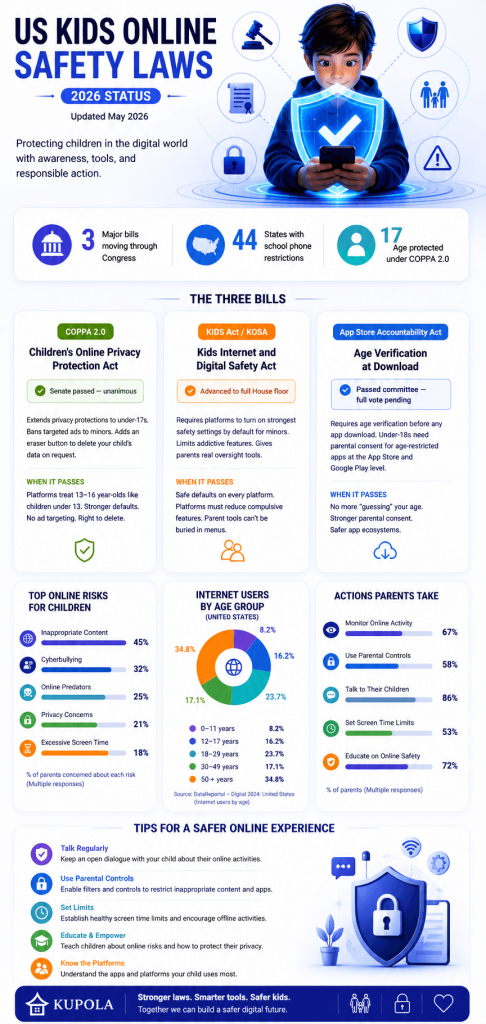
COPPA 2.0 — The One That Already Passed the Senate
COPPA, the Children’s Online Privacy Protection Act, has been federal law since 1998. It was written before social media existed. COPPA 2.0 is the update.
COPPA 2.0 covers ages 13 to 16, bans targeted advertising to minors entirely, and creates a dedicated FTC enforcement division — closing the loophole that allowed companies to treat teenagers as unprotected adult users. It also introduces an “eraser button” requirement, meaning parents and teens can demand that platforms delete a child’s personal data.
The Senate passed COPPA 2.0 unanimously in March 2026. That bipartisan agreement is significant. The House version is still in negotiation, but the unanimous Senate vote makes this the bill most likely to reach the President’s desk first.
What it means for parents when it passes: Platforms will have to treat your 13 to 16-year-olds the same way they currently treat children under 13. No targeted ads. Stronger default privacy settings. The right to delete your child’s data on request.
KOSA — The Kids Online Safety Act
KOSA is the broader of the two main bills. It requires platforms to implement safeguards that limit features that result in compulsive use, restrict communication with minors by default, provide easy-to-use parental oversight tools, and submit annual audited reports to the FTC on how minors use their platforms.
The Senate version of KOSA is stronger than the House version. The Senate bill includes a duty of care — a legal obligation for platforms to act in the best interests of children. The House version dropped that provision, which is why Democrats voted against it in committee. Despite that, the House KIDS Act — which folds KOSA into a broader package — advanced to the full House floor in March 2026.
What it means for parents when it passes: Social media platforms will have to enable their strongest safety settings by default for any user they know to be a minor. Parents will get real, working tools to manage their child’s account — not settings buried six menus deep.
The App Store Accountability Act — The One That Changes Downloads
This bill attacks the problem at a different layer. Instead of regulating what platforms do after a child signs up, it requires age verification before any app can be downloaded.
The App Store Accountability Act would require users under 18 to obtain parental consent before downloading age-restricted apps, with built-in enforcement mechanisms. In practice, that means Apple and Google would need to verify the age of every account holder and link child accounts to a parent before age-restricted apps can be installed.
The bill passed out of the House Energy and Commerce Committee in March 2026. It still needs a full House vote, then Senate passage, then presidential signature. However, four states — Utah, Louisiana, Texas, and Alabama — have already passed their own versions of this law.
What it means for parents when it passes: App downloads for minors will require your approval at the store level, before the app ever reaches the device. That closes one of the biggest gaps in current parental controls.
What Is Still Pending — And What That Means
All three bills have cleared the committee. None is the law yet. The path forward for each depends on a full House vote, Senate reconciliation, and a presidential signature. That process typically takes months, sometimes longer.
44 states and Washington D.C. have already implemented policies restricting smartphone use in schools, with the 2025–2026 school year being the first year many of these policies are fully implemented and tested. State-level action is moving faster than federal law. However, state laws vary significantly — what applies in Virginia does not apply in the same way in Florida.
The honest answer for parents: federal online safety laws for kids are coming, but they are not here yet. And even when they arrive, they will take 18 months or more to go into effect after signing.
What You Can Do Right Now — Without Waiting for Congress
The gap between where the law is today and where it is going is real. However, most of what these laws will eventually require from platforms, parents can already set up for themselves at the device level.
App download approval. The App Store Accountability Act will eventually require parental consent for downloads. You can enable this today. On iPhone, Screen Time requires your approval for every app installation. On Android, Google Family Link requires the same. Both work right now, at no cost. If you haven’t set this up yet, our guide on setting up your child’s first smartphone safely covers the exact steps for both platforms.
Default privacy settings. COPPA 2.0 will eventually require platforms to turn on the strongest settings by default for minors. Most platforms offer those settings today — they just don’t turn them on automatically. Go into Instagram, TikTok, and YouTube and set your child’s account to private, restrict who can message them, and turn off personalized recommendations. Do not wait for the law to do this for you.
Screen time and compulsive usage limits. KOSA will eventually require platforms to limit features that cause compulsive use. Kupola’s daily limits and scheduling tools do this at the device level right now — across every app, not just the ones that eventually comply with KOSA. A platform choosing not to comply with the law will still be subject to whatever limits you set on the device.
Visibility into what’s installed. None of these laws will tell you what your child already has on their phone. Kupola’s installed app list shows you every app on your child’s device, including ones that were downloaded quietly and moved off the home screen.
The Honest Take
These laws mark real progress. For years, platforms operated with their own rules and faced little to no consequences. That is now changing. Still, legislation progresses slowly, implementation takes more time, and enforcement takes even longer.
The families who will be most protected in the next two years are not waiting for Congress. They’ve already established household rules like app approvals, screen time limits, content filters, and monitoring their children’s online activity. When the laws are enacted, they will simply reinforce what those families have already put in place.
Download Kupola — set up the controls that these laws will eventually require platforms to implement. It takes about ten minutes.